Global Harmonisation in a Fragmented World
What is OICA?
The International Organization of Motor Vehicle Manufacturers (OICA) is the global association representing national automotive industry federations, including organisations such as CAAM. Often described as the equivalent of a global federation for the automotive sector, OICA brings together vehicle manufacturers from around the world through their national associations.
OICA currently has 36 member associations across all continents, representing all major vehicle manufacturing regions. The organisation has held official accreditation as a non-governmental organisation at the United Nations since 1956.
Approximately 90% of OICA’s activities are focused on automotive regulation at the United Nations. The organisation also publishes global vehicle production statistics, coordinates the international calendar of OICA-accredited motor shows and develops industry position papers, including the OICA Manifesto, through which manufacturers commit to achieving defined levels of vehicle performance.
OICA’s membership includes organisations such as the Alliance for Automotive Innovation in the United States, industry associations from Korea, the SMMT in the United Kingdom and associations from both large and smaller automotive markets. The network continues to expand and now includes most major automotive federations worldwide.
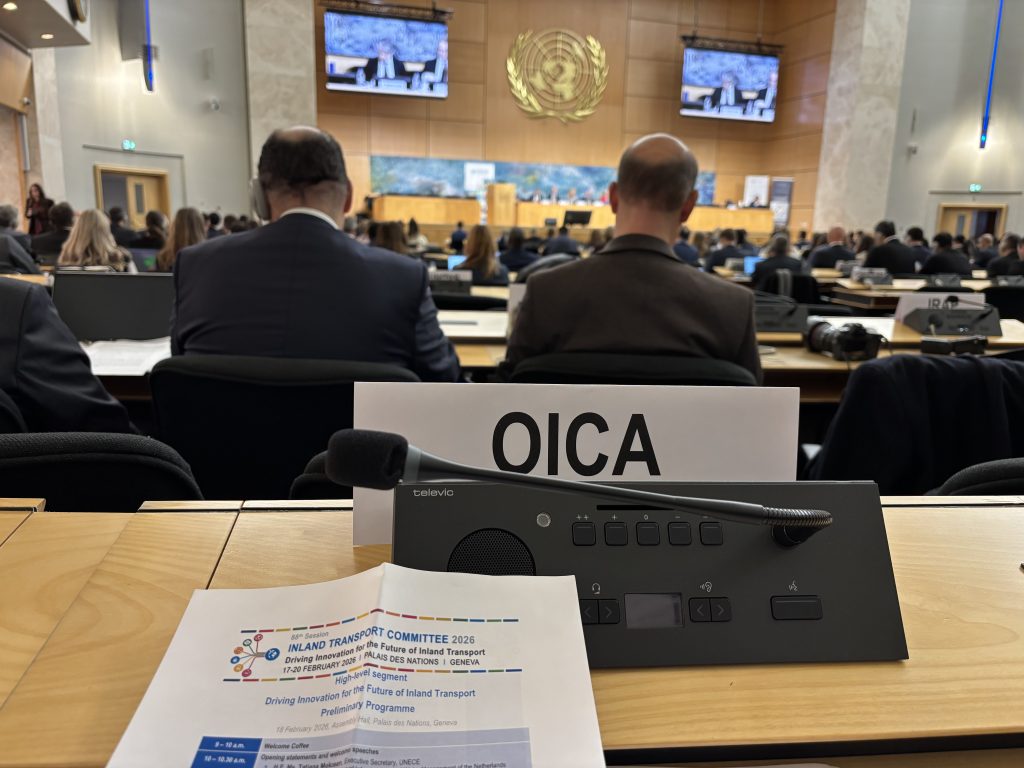
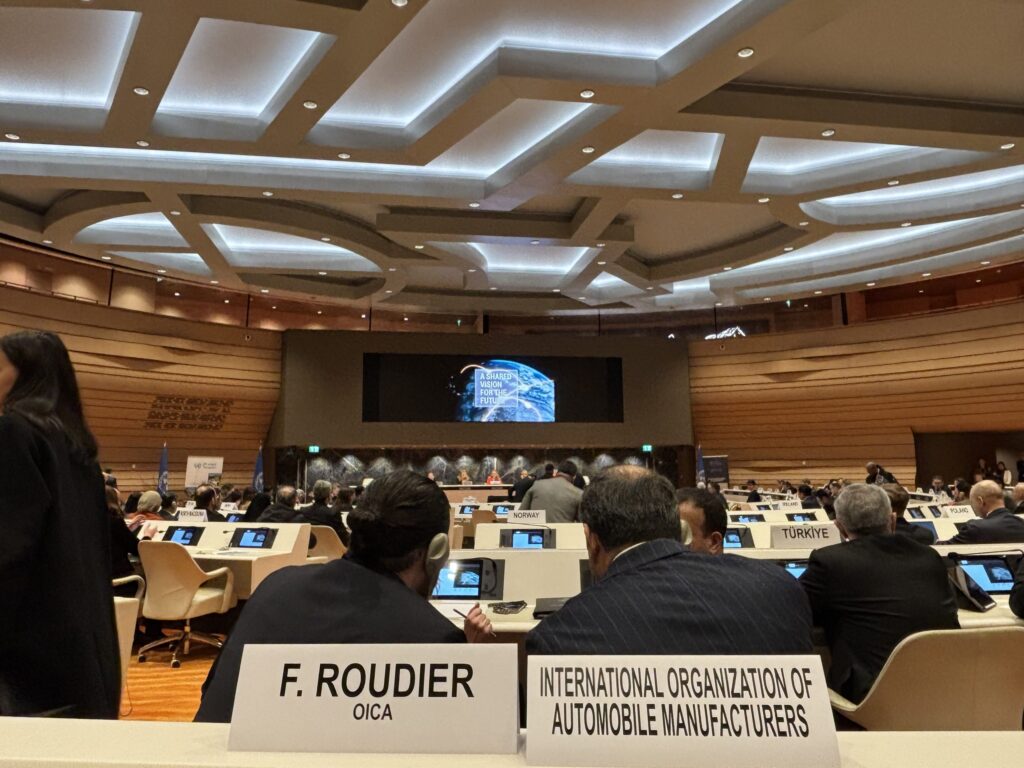
A significant part of OICA’s work takes place within the UNECE World Forum for Harmonization of Vehicle Regulations (WP.29).
WP.29 is organised through six specialised subsidiary working groups. OICA has established a technical structure that mirrors this organisation, ensuring that industry expertise is represented across all areas of regulatory development. The OICA Technical Committee reflects the structure of WP.29 and its subsidiary bodies, including GRVA, which is mirrored by OICA’s GEVA working group.
Before each GRX session in Geneva, OICA organises a corresponding preparatory meeting to develop common industry positions. These meetings typically bring together between 15 and 35 experts from around the world. Participation by Japanese and Korean manufacturers has been particularly consistent over many years, allowing them to contribute directly to the development of industry positions that are subsequently discussed within WP.29 and its subsidiary bodies.
This process is open to all manufacturers and associations. Greater participation enables stakeholders to contribute directly to technical discussions and the formulation of industry positions before regulations are finalised.
The Role of the Chinese Automotive Industry in Regulatory Harmonisation
The automotive industry operates on a global scale. Manufacturers seek to market vehicles in China, Europe, the United States, Japan, Korea and many other regions. When each market applies different regulatory requirements, the result is regulatory fragmentation.
Fragmentation creates challenges for Government Authorities, manufacturers and consumers alike.
For national authorities, it increases the burden of assessing vehicle compliance against unique national requirements. For manufacturers, it requires the development of multiple vehicle variants tailored to different regulatory frameworks rather than a single global product. Ultimately, these additional costs are passed on to consumers.
WP.29 was established to address this challenge by providing a platform for the global harmonisation of vehicle regulations.
Two principal international agreements form the foundation of this work:
- The 1958 Agreement, originally developed within Europe before progressively expanding worldwide. Today it is signed by 65 contracting parties.
- The 1998 Agreement, which was designed from the outset as a global framework and includes major automotive markets such as China, the United States, EU and India.
One of the greatest strengths of WP.29 is its role as a neutral platform for regulatory discussion. The process is not political in nature. Regulatory decisions are developed through broad consensus among participants, with the objective of establishing requirements that are acceptable to all contracting parties and that support global market access.
Over time, vehicle performance requirements continue to increase. This evolution is driven by two complementary forces.
The first comes mainly from governments and regulators, whose priorities usually focus on safety, environmental protection and security.
The second comes mainly from industry itself. Technological innovation frequently requires regulatory frameworks to evolve in order to accommodate new products and new forms of mobility.
Examples include e-trailers, where regulations are being adapted to allow technologies capable of reducing CO₂ emissions, and Automated Driving Systems (ADS), for which new international regulations have recently been adopted.
In the WP.29 process, Chinese manufacturers have traditionally relied on national authorities to represent their interests. However, participation through OICA provides an additional and highly effective channel for influencing the development of international regulations.
Engagement through OICA allows manufacturers to contribute at an earlier stage of the process, participating directly in the drafting and technical development of regulatory texts.
Two conclusions are particularly important.
First, stakeholders that participate in the drafting of international regulations are generally best positioned to influence their content. Rather than simply adapting products to regulatory requirements after they are adopted, manufacturers can contribute to shaping the regulations themselves through active participation in OICA working groups.
Second, seemingly minor technical details can have a significant impact on vehicle design and development. Discussions within OICA frequently address highly specific technical parameters that can ultimately shape future vehicle architectures and technologies. Early involvement therefore offers opportunities to influence issues that may later have important commercial and engineering consequences.
Global Harmonisation in a Fragmented World
Despite decades of progress in regulatory harmonisation, new forms of fragmentation are emerging.
Two significant drivers of fragmentation are currently shaping the global automotive landscape:
- The trade barriers resulting from tariffs introduced by the United States in recent years.
- Diverging approaches to electrification, with some regions pursuing mandatory electrification policies while others continue to rely on internal combustion technologies for a longer transition period.
These developments create additional complexity for manufacturers operating internationally.
The challenge is particularly significant because new automotive technologies require scale. Development costs are substantial, and the ability to deploy innovations across multiple markets is often essential to achieving economic viability and delivering benefits to consumers.
From a regulatory perspective, WP.29 remains one of the most effective mechanisms for reducing fragmentation and supporting market convergence.
At the same time, the platform itself continues to evolve. Participation from some regions, particularly parts of Africa, Latin America and Southeast Asia, remains limited. In addition, many countries apply UN regulations domestically without being formal contracting parties to the principal agreements. Expanding participation remains an important objective.
Within WP.29 and its subsidiary groups, OICA provides technical expertise to support the development of harmonised regulations. Harmonisation helps manufacturers access global markets, reduces administrative burdens for authorities and contributes to high standards of safety, environmental protection and consumer confidence. It also creates opportunities for economies of scale that benefit the entire automotive value chain.
To support this objective, OICA actively promotes the benefits of regulatory harmonisation and encourages broader international participation. In recent years, meetings and outreach activities have taken place outside Geneva, including sessions in Bangkok in 2025 and Montréal in 2026. A future WP.29 meeting is planned in Tokyo.
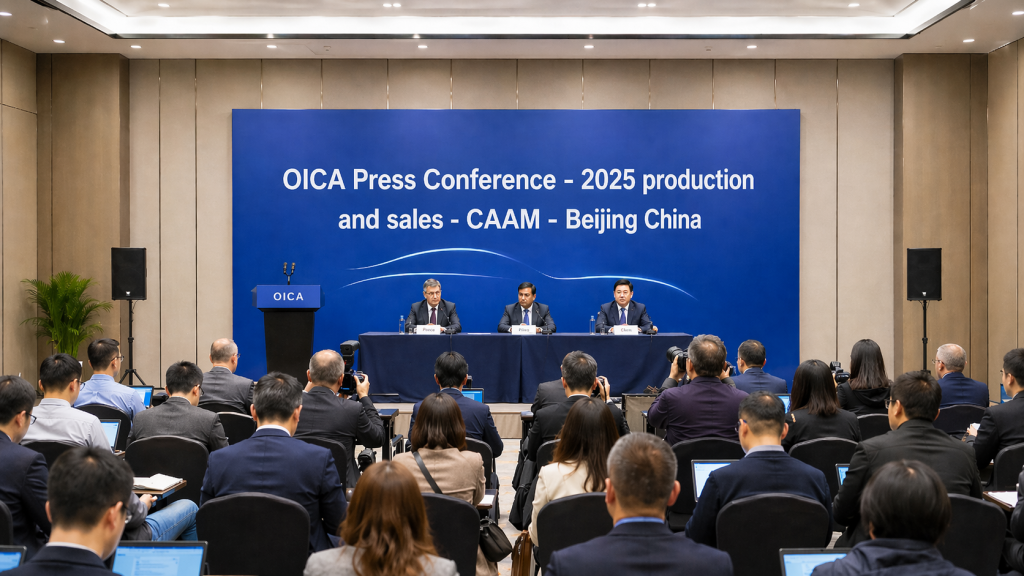
The forthcoming OICA Technical Committee meeting hosted by CAAM in Beijing will provide an additional opportunity for Chinese and other Asian stakeholders to engage directly with OICA activities and international regulatory discussions.
Conclusion
- OICA serves the global automotive industry through its regulatory expertise and its worldwide network of member associations.
- WP.29 provides a neutral and widely recognised framework for the development of harmonised automotive regulations. It creates a level playing field for regulators and supports greater regulatory convergence for manufacturers.
- While the system has historical roots in Europe, ongoing efforts are focused on making it increasingly global through broader participation and greater representation across all automotive regions.